
Coastal Commission Rules That Affect Newport Beach Landlords
Coastal commission rules that affect Newport Beach landlords: avoid costly fines by understanding permits, rental limits, and public access laws.


If you own a rental in Newport Beach, you already know the views come with rules. Many of those rules come from the California Coastal Commission, and they affect everything from remodels to short-term rentals. At Good Life Property Management, we have spent over 13 years managing Newport Beach and other Orange County properties, serving more than 1,000 property owners as “Coastal Asset Preservation” specialists. We are also proud members of the Newport Beach Chamber of Commerce and the Orange County Association of REALTORS® (OCAR). In this guide, we will walk you through the most important Coastal Commission rules that affect Newport Beach landlords, so you can protect your investment and avoid costly mistakes.
TL;DR
If you own a rental in Newport Beach, the California Coastal Commission likely has a say in what you can and cannot do with your property. Most remodels, ADUs, short-term rentals, and exterior changes inside the Coastal Zone require a Coastal Development Permit (CDP) on top of your regular city permits. Public access paths cannot be blocked, short-term rental rules change often, and bluff-front properties face extra setback and sea level rise review. When in doubt, check with the city’s Planning Division or a local property manager before you start any work.
Table of Contents
What Is the California Coastal Commission?
The California Coastal Commission is a state agency created by the Coastal Act of 1976. Its job is to protect public access to the coast and to guide development in coastal areas. The Commission has legal authority over a defined area called the Coastal Zone, which runs along the entire California coastline.
For most properties in Newport Beach, the city has its own Local Coastal Program (LCP) that has been approved by the Commission. So, many permit decisions are made by the city first. However, the Commission still sets the rules and can step in on appeals.
Is Your Newport Beach Property in the Coastal Zone?
Not every Newport Beach property falls under Coastal Commission rules, but many do. In fact, neighborhoods like Balboa Island, Corona del Mar, and Newport Coast all sit inside the Coastal Zone. The Balboa Peninsula, Lido Isle, Bay Shores, and much of West Newport do as well.
If you are unsure, check the City of Newport Beach Community Development maps or call the Planning Division. Also, your property's "appealable" status matters. Properties closer to the water, generally within 300 feet of the shoreline or inland wetlands, can have their permits appealed directly to the Commission even after the city approves them.
**** Click to make larger
Top Coastal Commission Rules Newport Beach Landlords Should Know
Below are the rules that most often catch landlords off guard.
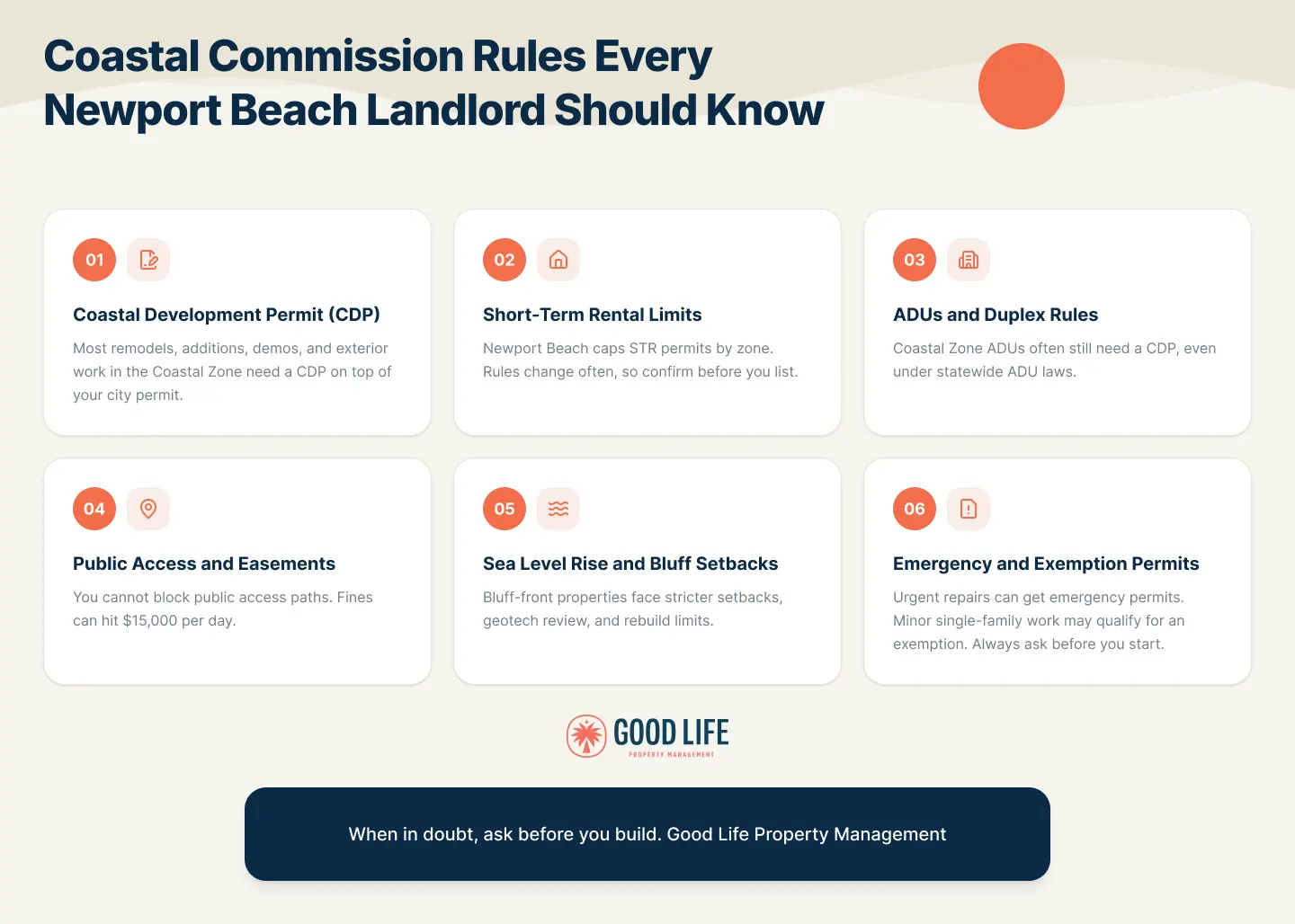
1. When You Need a Coastal Development Permit (CDP)
A Coastal Development Permit, or CDP, is required for most "development" in the Coastal Zone. The word "development" is broader than it sounds. It includes:
- New construction
- Additions or remodels that change the height or footprint of your building
- Demolitions
- A change in how the property is used, such as residential to commercial
- Grading or major landscaping
- New fences, walls, or decks near the shoreline
Cosmetic work like interior paint or new floors usually does not need a CDP. However, exterior changes almost always trigger review. When in doubt, call the city before you start work.
2. Short-Term Rental Rules
This is one of the most complex areas for Newport Beach landlords. The city limits short-term lodging permits and caps how many can exist in certain zones. The Coastal Commission has pushed back on many of these limits because it views vacation rentals as part of coastal access.
The result is an ongoing tug of war, so rules change often. If you plan to run a short-term rental, confirm current city rules, check that your property's zone allows STRs, and get the right permit before you list. If you plan to switch from a short-term to a long-term rental, you may avoid most of this friction. At Good Life, we focus only on long-term, unfurnished rentals for this exact reason.
3. ADU and Duplex Rules in the Coastal Zone
California has made it easier to build Accessory Dwelling Units (ADUs) across the state. However, in the Coastal Zone, an ADU may still require a CDP. The California Department of Housing and Community Development provides guidance on this. Duplex conversions under SB 9 also run into Coastal Act review in many cases.
So, before you add a unit to your Newport Beach property, plan for both city permits and Coastal Zone review. Our full Orange County landlord guide walks through the broader permit process.
4. Public Access and Beach Easements
If your property borders the beach or a public walkway, you likely have a public access easement on record. You cannot block that path with fences, furniture, or signs. Violations can bring fines of up to $15,000 per day under the Coastal Act.
Also, renters sometimes assume they can restrict beach access near their unit. They cannot, and the liability lands on you. Make sure your lease and house rules match Coastal Act requirements.
5. Sea Level Rise and Bluff Setbacks
Newer projects in Newport Beach must address sea level rise. If you own on a bluff, such as parts of Corona del Mar or Newport Coast, there are strict setback and geotechnical rules. Rebuilds after a storm or landslide face extra review. This affects both your insurance costs and your remodel options, so plan ahead.
6. Emergency and Exemption Permits
Not every project in the Coastal Zone needs a full CDP. The Coastal Act allows emergency permits for urgent work, such as storm damage repairs, a failing seawall, or threats to public safety. You can start the work quickly and then file the paperwork with the city or Commission after the fact.
The Act also allows exemption permits for certain small projects, like basic repairs or improvements to an existing single-family home that do not expand the footprint. If you think your project might qualify, ask the Planning Division before you start. An exemption can save you months of review time, but only if it is approved in writing.
Other Laws to Know
Coastal Commission rules are only part of the picture. Newport Beach landlords also need to follow state and county laws. Make sure you understand the Orange County rent control rules, the latest rental laws passed each year, and the new security deposit rules under AB 2801. These layer on top of the Coastal Act, so a mistake in one area can still cost you even if you follow the other.
Common Mistakes Newport Beach Landlords Make
Here are the pitfalls we see most often:
- Starting a remodel without checking if a CDP is needed
- Blocking a public access path with a new fence, gate, or planter
- Adding an ADU without Coastal Zone approval
- Listing on Airbnb without a current short-term lodging permit
- Assuming that a city permit is the same as Coastal Commission sign-off
Any one of these can lead to stop-work orders, fines, or forced teardowns. Plan the paperwork before the shovel hits the ground.
Frequently Asked Questions
Do I always need a Coastal Commission permit, or is a city permit enough?
It depends on your property’s location and the type of work. For most projects inside Newport Beach’s Local Coastal Program area, the city handles the CDP. However, for “appealable” properties near the water, the Commission may still have a say.
Does the Coastal Act apply to single-family rentals, or only large projects?
It applies to both. Even small exterior changes to a single-family rental can trigger review if the property sits in the Coastal Zone.
Can I rent my Newport Beach property short-term?
Sometimes. You need a city short-term lodging permit, and the property must be in a zone that allows it. Rules change often, so verify before you list.
What happens if I violate a Coastal Commission rule?
Penalties can include stop-work orders, daily fines up to $15,000, and orders to remove unpermitted work. In serious cases, the Commission can pursue legal action.
How long does a CDP take to get approved?
Simple CDPs in Newport Beach can take a few months. Complex or appealable projects can take a year or more.
When in Doubt, Get Help
The Coastal Act rewards careful planning and punishes guesswork. If you are unsure whether a project, rental type, or renovation is compliant, talk to a licensed property manager or a Coastal Zone attorney before you move forward. Our Newport Beach property management team tracks these rules every day, and we are happy to answer questions at no cost to you.
The Bottom Line
Owning a rental in Newport Beach is one of the best long-term investments in Southern California. But the coast comes with rules that most inland owners never have to think about. If you know the basics of the Coastal Act, the CDP process, and the local short-term rental limits, you will avoid the biggest headaches. If you would rather hand off the paperwork and stay focused on your life, we are here to help.
Blogs

SB 1051: Key Changes for California Landlords in 2025
Learn about SB 1051 and its impact on California landlords starting January 2025. Understand new obligations regarding lock changes and tenant protections.

Free Rent Invoice Template for Landlords
If you have a rental property, rent invoices should be a part of your payment process. Get our free rent invoice template and learn how to use it effectively.

Is Your “Negative Cash Flow” Rental Actually Building Wealth?
Think your rental isn’t worth it because of negative cash flow? Learn how you could still be gaining wealth through appreciation, amortization, and tax savings.