
Orange County Housing Market 2026: Prices, Forecast, Inventory, and Rental Trends
Orange County remains one of the most expensive housing markets in the country, but in 2026 it is splitting into two speeds. Here is what owners and investors need to know about coastal and inland prices, rents, inventory, and where the market may be heading.


Key Takeaways
- Orange County is one of the most expensive housing markets in the U.S., and in 2026 it is running at two speeds.
- The priciest markets, like Newport Beach and Irvine, have cooled and now give buyers more room to negotiate.
- More affordable inland cities, like Santa Ana and Anaheim, are seeing the strongest demand and price growth.
- Prices are up modestly overall, with the county median around $1.26 million, about 4.7% higher than a year ago.
- Inventory has improved from recent lows, and mortgage rates sit around 6.5%, down from last year.
- The rental market stays tight and landlord-friendly, with vacancy around 4% to 4.5% and rents near $2,800.
- Bottom line: for owners and investors, location and price tier matter as much as timing.
For 13 years, Good Life Property Management has helped people own and rent homes across Southern California. Today, our local Orange County team, based in Irvine, manages long-term rentals across 40-plus OC cities, including Newport Beach, Irvine, and Santa Ana. Because we manage homes in both wealthy coastal towns and more affordable inland cities, we see the Orange County housing market from the inside every day. So if you are thinking about buying, selling, or holding, here is a clear and honest look at where the market stands now and where it may be heading.
Here is the big picture. Orange County remains one of America's most expensive housing markets. However, a deepening affordability crunch is splitting it into a two-speed market. Premium coastal communities still command the highest prices, even as the luxury end cools and gives buyers more room to negotiate. Meanwhile, more affordable inland cities are drawing the strongest demand and price growth, as priced-out buyers chase value. In short, where you look matters as much as when you look.
Table of Contents
- Orange County Housing Market Snapshot
- The Affordability Squeeze in Orange County
- Orange County Home Prices: High but Leveling Off
- Orange County Housing Market Trend: The Coastal vs. Inland Divide
- Why Orange County Inventory Is Finally Rising
- The Orange County Rental Market in 2026
- HOA Costs, Insurance, and Other Rising Expenses
- Are Orange County Property Values Still Rising?
- Orange County Housing Market Forecast 2026 and Beyond
- What the Coastal vs. Inland Divide Means for Buyers, Owners, and Investors
- Frequently Asked Questions
- Make Orange County Property Ownership Easy
Orange County Housing Market Snapshot
First, here is where things stand today. The Orange County real estate market is not the frenzy it was during the 2020 to 2022 boom, but it is not crashing either. Instead, it is expensive, competitive in the right price ranges, and slowly rebalancing. The table below breaks down the key numbers and what they mean.
| Market Factor | Current Signal | What It Means |
|---|---|---|
| County median sale price | About $1.26 million, up about 4.7% year over year (Redfin, May 2026) | Prices are high and still rising modestly overall. |
| Affordability | About 22% of Californians can afford the state median home, and OC is among the least affordable counties (C.A.R.) | Affordability is the market's defining pressure. |
| Active listings | Improved from recent lows | Inventory is rising, giving buyers more choices. |
| Median days on market | About 38 days | Homes still sell, but buyers are taking more time. |
| 30-year mortgage rate | Around 6.5% (Freddie Mac) | Down from a year ago, but still limits buyer budgets. |
| Average rent | Around $2,800 by mid-2026, up about 4% over two years (USC Casden forecast) | Rents are high, but rent growth has slowed. |
| Rental vacancy | Around 4% to 4.5% (USC Casden forecast) | Still relatively tight and landlord-friendly. |
In short, Orange County is costly but stable. Buyers have a bit more room than they did two years ago. Sellers still do well with smart pricing. Investors continue to benefit from high rents and low vacancy. Based on current supply, rates, and affordability, our Orange County housing market forecast is for modest price movement, stronger inland demand, and a rental market that remains tight. Next, here is what is driving these numbers, starting with the force behind almost everything else.
The Affordability Squeeze in Orange County
Affordability is the single biggest story in the Orange County housing market, and it explains nearly every other trend below. Home prices here run far above the national average, and the math is tough for most buyers. In fact, the monthly payment on a median-priced home now eats up a very large share of the typical household's income. According to the California Association of Realtors, only about 22% of California households could afford the state's median-priced home in early 2026, and that share was lower, around 18%, for the wider Los Angeles metro area that includes Orange County. In practice, Orange County is even less affordable, since it ranks among the priciest counties in the state.
Because of this squeeze, three things happen. First, many would-be buyers stay renters longer, which keeps rental demand strong. Second, buyers who do shop are cautious and value-focused, so they negotiate harder. Third, demand shifts toward more affordable inland cities, which pushes prices up there even as the high end cools. Keep this in mind as you read on, because affordability is the thread that ties the whole market together.
Orange County Home Prices: High but Leveling Off
Orange County home prices remain among the highest in the country. That said, the days of rapid, across-the-board jumps have cooled. Countywide, the median sale price sits around $1.26 million, up about 4.7% over the past year according to Redfin, though different data sources report somewhat different figures depending on how they measure. Most forecasts now expect only low-single-digit appreciation of about 1% to 3% in 2026.
The main reason prices stay firm is simple. Orange County does not have enough homes. Limited land, built-out cities, and slow new construction keep supply tight, which puts a floor under property values even when demand softens. As a result, this is not a market headed for a sharp drop. For county-wide price data, both the California Association of Realtors and Redfin track Orange County medians, and our own view from managing homes here matches that picture: steady values, with the real action happening at the city level.
Orange County Housing Market Trend: The Coastal vs. Inland Divide
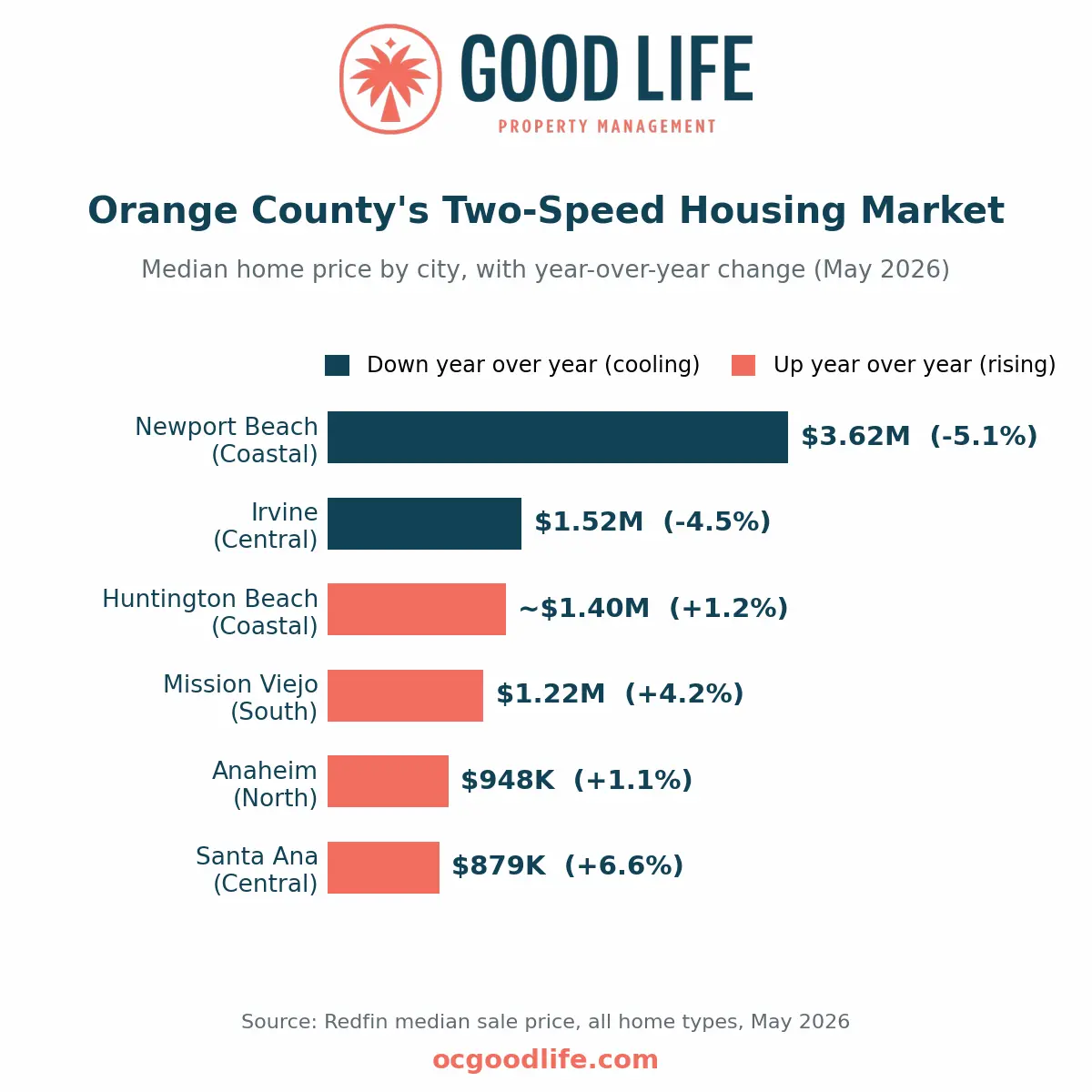
This is where the two-speed market really shows up, and it is the most important section for understanding Orange County today. The price level still follows the old rule, with coastal and master-planned cities far more expensive than inland ones. However, the recent momentum runs the other way. The priciest markets are cooling, while the more affordable inland cities are heating up. The table below shows it clearly.
| City | Area | Median Sale Price | Year-Over-Year Change |
|---|---|---|---|
| Newport Beach | Coastal | $3,617,835 | -5.1% |
| Irvine | Central | $1,524,088 | -4.5% |
| Huntington Beach | Coastal | About $1,400,000 | +1.2% |
| Mission Viejo | South | $1,224,267 | +4.2% |
| Anaheim | North | $948,427 | +1.1% |
| Santa Ana | Central | $879,474 | +6.6% |
Source: Redfin, median sale price for all home types, May 2026. City medians can swing with the mix of homes sold, especially in low-volume luxury markets, so treat the price levels as the durable story and the year-over-year changes as the direction of momentum.
Notice the pattern. The two most expensive markets, Newport Beach and Irvine, are down from a year ago, while the more affordable cities are flat to up. In fact, as a rule, the lower the price tier, the stronger the gains, with Santa Ana leading the way. Huntington Beach, a coastal city, sits in the middle and holds roughly flat. In the high-end communities we manage, we have seen this firsthand: luxury homes sit a bit longer, and sellers are more willing to deal. Meanwhile, in inland cities, well-priced homes still draw strong interest because that is where buyers can actually afford to compete. If you want to dig into the strongest investment spots, our guide to the best Orange County neighborhoods for rental property investment is a helpful next step.
Why Orange County Inventory Is Finally Rising
For years, a lack of homes for sale defined the Orange County housing market. Now, that is slowly changing, as more homes have come up for sale and inventory has improved from its recent lows. So what is behind the shift? A few things are happening at once.
First, the mortgage rate lock-in effect is easing. Many owners held onto low pandemic-era rates and refused to sell, but as rates drift down and life events pile up, more of them are finally listing. Second, sellers are accepting today's reality. Instead of chasing 2022 prices, more are pricing to the current market, which helps deals close. Third, some inland areas are seeing more new construction, including accessory dwelling units that add gentle supply. Fourth, buyers have grown more selective, so homes that are dated or overpriced now sit longer rather than selling in a weekend.
To be clear, inventory is rising from very low levels, so this is a rebalancing, not a flood. Still, more choices and more negotiating room are good news for buyers, especially at the higher end of the market. Buyers searching for Orange County homes for sale now have more options than they did during the tightest part of the market, but the best-priced homes still move quickly.
The Orange County Rental Market in 2026
The rental market is where our experience runs deepest, since managing long-term rentals is what we do every day. The short version is that Orange County remains a strong, landlord-friendly rental market, even as growth cools. Vacancy sits around 4% to 4.5%, which is well below the national average, according to USC's Casden multifamily forecast, and the county's renter population is about 43.5%, compared with roughly 34% nationally, per the U.S. Census Bureau. With so many renters and so few new units, demand stays high.
That said, rent growth has slowed to around 3% a year, and it varies by location. Coastal cities are seeing slower growth of about 1% to 2%, while north county and inland areas are pushing closer to 3% to 4%. From what we see on the ground, single-family rentals are especially strong right now, because families priced out of buying are renting houses longer and tend to stay put. For owners, the lesson is to price to today's market, not last year's. If you want a clear starting point, you can estimate your Orange County rental income with our free tool.
One more thing to watch is the law. California's statewide rent cap under AB 1482 limits annual increases, and in Orange County that ceiling currently lands around 8% to 9% depending on inflation. You can read the details of the law in the official AB 1482 text, and our overview of Orange County rent control rules breaks down what it means for landlords.
HOA Costs, Insurance, and Other Rising Expenses
Owning a home or condo in Orange County is not just about the purchase price. The cost of keeping a property has climbed too, and this matters for both values and cash flow. For example, landlord insurance costs in Orange County have squeezed many owners, as premiums have climbed sharply in recent years.
Condo and townhome owners face an extra layer. A state law called SB 326 requires condo associations with three or more units to inspect their elevated balconies, walkways, and stairs, then re-inspect every nine years. You can review the rules in the official SB 326 text. These inspections and any needed repairs can be costly, which often leads to higher HOA dues or special assessments. As a result, buyers tend to discount older attached homes with high or rising HOA costs, just as we have seen in other Southern California markets.
Are Orange County Property Values Still Rising?
Orange County property values are still rising overall, but the gains are not even across the county. Coastal and luxury markets have cooled in some areas, while more affordable inland cities continue to show stronger demand. This is why investors should not rely only on countywide averages. A rental property in Santa Ana, Anaheim, or Garden Grove may perform very differently than a home in Newport Beach or Irvine.
Orange County Housing Market Forecast 2026 and Beyond
So where is the Orange County housing market headed? While no one can predict the future with certainty, the current trends point the way. Most Orange County housing market predictions expect modest price growth of about 1% to 3% in 2026, with the two-speed pattern continuing. In other words, affordable inland cities should keep outperforming, while the luxury coast stays flat or cools further until buyers adjust.
Mortgage rates are the big wildcard in any Orange County housing market forecast. Rates have eased into the mid-6% range, down from a year ago, and you can track current rates through Freddie Mac's weekly survey. If rates fall further, demand and prices could pick up, especially at the high end. On the rental side, tight supply should keep vacancy low and rents firm, so owners can expect steady, if slower, growth.
What the Coastal vs. Inland Divide Means for Buyers, Owners, and Investors
Because the market is split, the right move depends on what you want and where you are looking. To make it practical, here is how we would frame it.
If you are buying to live in, the calmer pace gives you more time to compare homes and negotiate, especially in pricier coastal areas where sellers are more flexible. If you are an investor, inland cities offer the strongest mix of affordability, demand, and rent growth, while single-family rentals across the county remain a dependable play. If you already own a rental, price it to today's market and lean on the low vacancy in your favor. And if you are weighing your options on a property you no longer want to manage, our rent vs. sell calculator for Orange County owners can help you run the numbers. For comparison, you can also see how the neighboring market is moving in our San Diego guide.
Frequently Asked Questions
Is the Orange County housing market going up or down in 2026?
It depends on the price tier and the location. Overall, prices are up modestly. However, the picture splits in two: the most expensive markets, like Newport Beach and Irvine, are down from a year ago, while more affordable cities like Santa Ana, Anaheim, and Mission Viejo are rising.
Are Orange County home prices dropping?
Not across the board. The high end is softening, with the most expensive markets like Newport Beach and Irvine down year over year. At the same time, low inventory and strong demand are keeping more affordable areas firm or rising, with Santa Ana up the most. A broad, sharp drop is unlikely while supply stays this tight.
Is the Orange County housing market in a bubble?
The data does not point to a bubble like 2008. Homeowners hold strong equity, lending standards are far tighter than they were back then, and a persistent shortage of homes supports current values. Most experts expect a slow rebalancing, not a crash.
What is the cheapest area to live in Orange County?
Among the larger cities, inland areas tend to be the most affordable. Santa Ana and Anaheim offer lower median prices than coastal cities, which is one reason demand and prices there have been rising as buyers look for value.
Is it a buyer's or seller's market in Orange County?
It is a mix. In high-priced coastal markets, buyers have gained more room to negotiate as homes sit longer. In affordable inland cities, sellers still hold the edge, since well-priced homes often draw multiple offers. Overall, the market is more balanced than it was in 2021.
How much is rent in Orange County?
The average rent is around $2,800, though it varies widely by city and home size. Coastal cities run higher, while inland areas are more affordable. Rent growth has cooled to about 3% a year.
Is Orange County a good place to invest in rental property?
For many owners, yes. Vacancy is low, the renter population is large, and single-family rentals are in strong demand. The cost of entry is high, but tight supply and durable demand make Orange County rentals a solid long-term investment, especially in inland areas with room for rent growth.
Make Orange County Property Ownership Easy
Not sure whether your Orange County property fits the current rental market? Good Life can help you compare rent potential, local demand, expenses, and long-term strategy before you decide whether to buy, sell, or hold. So whether you already own a rental here or are just thinking about it, our team is ready to help with Orange County property management services built on local experience.
Blogs

How Property Management Accounting Should Maximize Your ROI
Discover how property management accounting can maximize your ROI with clear reporting, tax prep, and financial safeguards for your rentals.

How to Become a Landlord: The Ultimate Guide
In this guide on becoming a landlord, we’re sharing everything you need to know about the transition so you know what to expect from day one.

Prop 33 Defeated: A Huge Win for California’s Housing Market
Prop 33 has been defeated! Learn how California voters protected private property rights and preserved a healthy housing market through advocacy and action.