
How to Rent Out Your House in California: Step-by-Step Tips
Learn how to rent out your house with our complete guide. Discover tips, legal steps, and expert advice for first-time landlords.


Thinking about renting out your home? You are not alone. Many Orange County homeowners are turning their properties into income-producing assets. But knowing where to start can feel overwhelming. There are rules to follow, decisions to make, and risks to avoid.
At Good Life Property Management, we have been helping homeowners rent out their homes since 2013. We manage over 1,200 properties across San Diego and Orange County. Our team holds industry certifications including PMC (Property Management Certification) and CCRM credentials. In short, we have seen it all — and we are here to guide you through it.
This guide will walk you through everything you need to know about how to rent out your home. Whether you are a first-time landlord or a seasoned investor, you will find clear, honest answers here.
TL;DR — How to Rent Out Your Home
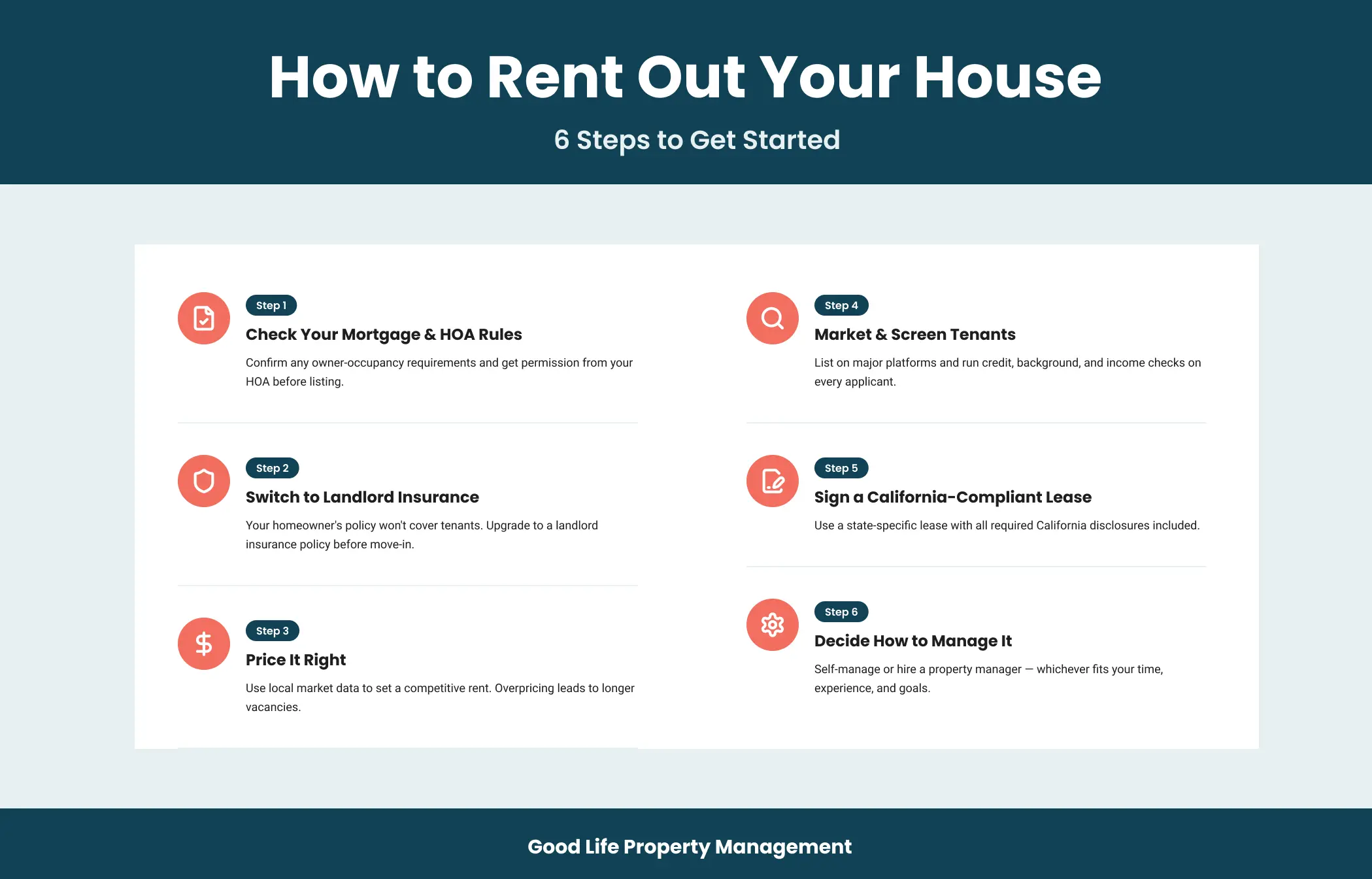
Renting out your home in California involves six key steps: verify your mortgage terms, update your insurance to a landlord policy, check local city and HOA rules, price the rental using market data, screen tenants carefully, and sign a California-compliant lease.
California landlords must follow state-specific laws, including AB 1482 rent control rules, a two-month security deposit cap, required habitability standards, and just-cause eviction protections for tenants after 12 months. Most mortgage lenders require you to live in the home for at least 12 months before converting it to a rental. California does not require a statewide landlord license, but some cities in Orange County require business licenses or rental property registration.
Rental income is taxable, but landlords can deduct mortgage interest, repairs, insurance, property management fees, and depreciation. Orange County single-family homes typically rent for $2,500 to $5,000+ per month. Homeowners can self-manage or hire a licensed property management company to handle leasing, tenant screening, maintenance, and legal compliance.
Table of Contents
- Is It Profitable to Rent Out a Home?
- Reasons to Rent Out Your Home
- How Much Do Landlords Make Per House?
- Do I Need Permission to Rent Out My House?
- Can I Rent Out My House Without Telling My Mortgage Lender?
- How Long Do You Have to Live in Your Primary Residence Before Renting?
- How to Rent Out Your House with a Mortgage
- Do I Need a License to Rent My House in California?
- How to Rent Out Your House in California
- Renting Out Your House: Tax Implications
- How to Rent Out Your House for the First Time
- Do I Need a Property Manager to Rent My Home?
- How to Rent Out Your House with Property Management
- Renting Out Your House Checklist
- How Do I Start the Process of Renting Out My Home?
**** Click image to make larger
Is It Profitable to Rent Out a Home?
Yes — renting out your home can be very profitable. However, it depends on your local market, your expenses, and how well you manage the property.
In Orange County, rental demand is consistently high. The average rent for a single-family home has remained strong for years. That means well-maintained properties in good locations tend to stay rented and generate solid cash flow.
That said, profitability is not guaranteed. You need to factor in:
- Mortgage payments (if applicable)
- Property taxes
- Insurance (more on this below)
- Maintenance and repairs
- Vacancy periods
- Property management fees (if you hire help)
Want to know what your home could rent for right now? Use our Free Instant Rent Estimator to get a data-backed estimate in seconds.
Reasons to Rent Out Your Home
There are many good reasons to rent out your home. Here are the most common ones we hear from our clients:
You want extra income. Rental income can help cover your mortgage, fund retirement, or pad your savings.
You need to relocate. Maybe your job moved you across the country. Renting out your home lets you hold onto the property while you are away.
You inherited a property. If you recently came into a home you did not plan for, renting it out is often a smart move. Check out our guide on So You Inherited a House, Now What? for more help.
You want to build long-term wealth. Real estate is one of the most reliable ways to build equity over time. Renting keeps your asset working for you.
The market is not right to sell. Sometimes it makes more sense to hold and rent than to sell at the wrong time.
Whatever your reason, renting can be a smart financial decision when done correctly.
How Much Do Landlords Make Per House?
This is one of the most common questions we get. And the honest answer is: it varies widely.
In Orange County, monthly rents for single-family homes typically range from $2,500 to $5,000+, depending on size, location, and condition. After expenses, many landlords net between $500 and $2,000 per month in positive cash flow.
Of course, your numbers will look different depending on:
- Whether you have a mortgage
- Your property’s condition
- How often it is vacant
- Whether you self-manage or hire a property manager
A good rule of thumb is the 1% rule, which means your monthly rent should be at least 1% of the property’s purchase price. For example, a $500,000 home should ideally rent for at least $5,000 per month. In Orange County’s high-cost market, this can be difficult to achieve. However, appreciation potential often makes up for lower cash-on-cash returns.
Want a clearer picture of your costs? Try our Property Management Cost Calculator to see how different scenarios might play out for your property.
Do I Need Permission to Rent Out My House?
In most cases, you do not need special permission from the government to rent out a single-family home. However, there are some important exceptions.
HOA Rules: If your home is in a homeowners association (HOA), check the CC\&Rs. Many HOAs in Orange County restrict or regulate short-term and long-term rentals. Some require you to notify them before renting. Others may prohibit it entirely.
Local Ordinances: Some cities in Orange County have specific rules about rental properties. For example, certain cities require rental inspections or registrations.
Mortgage Lender Requirements: Your lender may also have a say (see the section below on renting with a mortgage).
The safest approach is always to review your HOA documents, check your city's local regulations, and speak with your lender before putting your home on the market.
Can I Rent Out My House Without Telling My Mortgage Lender?
Technically, you can, but you probably should not.
Most conventional mortgage loans include an owner-occupancy clause. This means you agreed to live in the home as your primary residence. Renting it out without notifying your lender could put you in violation of your loan agreement.
In practice, lenders rarely check up on this. But if they find out, through an insurance change, a tax filing, or another route, they could call the loan due in full.
Here is what we recommend:
- Read your loan documents. Look for any owner-occupancy requirements.
- Talk to your lender. Many lenders will simply update your file. Some may require a change to a non-owner-occupied loan.
- Update your insurance. This will likely trigger a conversation with your lender anyway (and it is required).
Being upfront now is far better than dealing with a legal headache later.
How Long Do You Have to Live in Your Primary Residence Before Renting?
This depends on your loan type.
Conventional loans: Most require you to live in the home for at least 12 months before converting it to a rental. However, your specific loan agreement may differ.
FHA loans: The Federal Housing Administration requires borrowers to occupy the home as their primary residence within 60 days of closing and for at least one year before renting.
VA loans: The VA requires the borrower to occupy the property within a “reasonable time” and intend to continue living there. Converting to a rental right away may be a violation.
There are exceptions for major life changes like job relocations, military deployments, or family hardships. Always check with your lender directly before making a move.
How to Rent Out Your House with a Mortgage
Having a mortgage does not stop you from renting out your home. Millions of landlords across the country do exactly this.
Here is how to do it properly:
Step 1: Review your mortgage terms. Confirm any owner-occupancy requirements and timelines.
Step 2: Notify your lender. Let them know your plans. In many cases, this is a simple process.
Step 3: Update your insurance. Your homeowner’s policy will no longer cover the property as a rental. You will need landlord insurance instead. Not sure about the difference? Read our guide: Homeowner’s Insurance vs. Landlord Insurance.
Step 4: Run your numbers. Make sure the rent will cover your mortgage plus other expenses. A property that loses money each month is a liability, not an asset.
Step 5: Set up a separate bank account. Keep your rental income and expenses separate from your personal finances. This makes tax time much easier.
Do I Need a License to Rent My House in California?
California does not require a statewide license to rent out a single-family home. However, some cities and counties have their own requirements.
For example:
- Some cities require a business license for residential landlords.
- Others require rental property registration.
- Some jurisdictions require a rental inspection before a tenant can move in.
In Orange County, requirements vary by city. Cities like Anaheim, Huntington Beach, and Irvine each have their own rules. Before you list your property, check with your local city government to find out what applies to you.
Additionally, California law requires landlords to meet strict health and habitability standards. You must ensure your property has working plumbing, electricity, heat, and structural safety.
How to Rent Out Your House in California
California is a tenant-friendly state. That means landlords have more obligations here than in most other states. Understanding the rules upfront will save you a lot of headaches.
Here are the key California-specific requirements you need to know:
Rent Control: Under California’s AB 1482, many single-family homes are exempt from statewide rent control; but not all. If your home was built before 2007 and does not qualify for an exemption, rent increases may be capped.
Security Deposits: California limits security deposits to two months’ rent for unfurnished homes and three months’ rent for furnished ones. (Should I rent my property furnished or unfurnished? Get answers now)
Habitability Standards: California Civil Code requires landlords to maintain properties in a livable condition. This includes working heat, plumbing, weatherproofing, and more.
Disclosure Requirements: California requires landlords to provide tenants with several disclosures, including information about lead paint, mold, and the presence of any death on the property within the past three years.
Just Cause Eviction: Under AB 1482, tenants who have lived in a property for more than 12 months are protected from no-cause evictions in many cases.
Working with a California-licensed property management company can help ensure you stay in full compliance. Good Life Property Management specializes in exactly this.
Renting Out Your House: Tax Implications
Renting out your home has significant tax consequences. Here is a quick overview — but always consult a tax professional for advice specific to your situation.
Rental Income Is Taxable: All rental income must be reported on your federal and state tax returns.
You Can Deduct Expenses: The good news is that many expenses are deductible, including:
- Mortgage interest
- Property taxes
- Insurance premiums
- Repairs and maintenance
- Property management fees
- Depreciation
Depreciation Is a Powerful Deduction: The IRS lets you depreciate a residential rental property over 27.5 years. This creates a non-cash deduction that can significantly reduce your taxable income.
Capital Gains Tax: If you sell the property after renting it out, you may owe capital gains tax. The Section 121 exclusion (which lets you exclude up to $250,000 in gains if you lived there for 2 of the last 5 years) may or may not apply, depending on how long you rented it.
Passive Activity Rules: If you are not a real estate professional, your rental losses may be limited by passive activity rules.
Important note: talk to a CPA who understands California real estate tax law before you finalize your plans.
How to Rent Out Your House for the First Time
If this is your first time renting out a property, it can feel like a lot. But breaking it into steps makes it manageable.
Here is a simple process to follow:
1. Prepare the property. Make any needed repairs. Deep clean everything. Consider fresh paint and professional photos.
2. Set the right rent price. Use market data to price your home competitively. Overpricing leads to longer vacancies. Our Free Instant Rent Estimator can help.
3. Market the property. List it on major platforms like Zillow, Trulia, and Apartments.com. Good photos and a compelling description make a big difference.
4. Screen your tenants carefully. Run credit checks, background checks, and verify income. California law has specific rules about what you can and cannot consider during screening.
5. Draft a solid lease. Use a California-compliant lease agreement. Include all required disclosures.
6. Conduct a move-in inspection. Document the condition of the property before the tenant moves in. Take photos and have the tenant sign a property inspection checklist.
7. Collect rent and stay organized. Set up a reliable system for collecting rent and tracking expenses from day one.
Do I Need a Property Manager to Rent My Home?
You do not need a property manager. But for many homeowners, hiring one is one of the best decisions they make.
Here is a simple way to think about it:
You may NOT need a property manager if:
- You live near the property and can handle maintenance calls quickly
- You have experience with landlord-tenant law in California
- You enjoy the day-to-day tasks of managing a rental
- Your property is in excellent condition and low-maintenance
You PROBABLY DO need a property manager if:
- You live out of the area or travel frequently
- You are not familiar with California’s complex landlord laws
- You have a demanding full-time job and limited free time
- You want to protect your investment without the stress
A professional property manager handles tenant screening, lease drafting, maintenance coordination, rent collection, and legal compliance — all for a monthly fee.
How to Rent Out Your House with Property Management
Working with a property management company removes much of the stress and risk from being a landlord.
Here is what a full-service property manager typically does:
- Determines the right rent price using real-time market data
- Markets the property across multiple platforms
- Screens tenants using rigorous background and credit checks
- Drafts a legally compliant lease with all required disclosures
- Collects rent and enforces late fees
- Coordinates maintenance and repairs using vetted vendors
- Handles tenant communications and disputes
- Manages move-in and move-out inspections
- Provides monthly financial reporting
At Good Life Property Management, we have been doing this since 2013. We manage over 1,200 properties across Orange County and San Diego. Our team holds PMC and CCRM certifications, and our processes are built around California compliance.
Curious about what it would cost? Use our Property Management Cost Calculator to get a quick estimate.
Renting Out Your House Checklist
Before you hand over the keys, make sure you have covered all these bases:
Legal & Financial
- [ ] Reviewed mortgage for owner-occupancy requirements
- [ ] Notified lender of intent to rent (if required)
- [ ] Switched from homeowner's to landlord insurance
- [ ] Checked city/HOA rules for rental permissions
- [ ] Consulted a tax professional about rental income
Property Preparation
- [ ] Completed all necessary repairs
- [ ] Ensured property meets California habitability standards
- [ ] Deep cleaned the property
- [ ] Taken professional photos
Tenant Marketing & Screening
- [ ] Priced the rental using current market data
- [ ] Listed on major rental platforms
- [ ] Created a tenant screening process (credit, background, income)
Lease & Move-In
- [ ] Used a California-compliant lease agreement
- [ ] Included all required California disclosures
- [ ] Collected first month's rent and security deposit
- [ ] Conducted and documented a move-in inspection
Ongoing Management
- [ ] Set up rent collection system
- [ ] Created a separate bank account for rental income
- [ ] Established relationships with reliable maintenance vendors
How Do I Start the Process of Renting Out My Home?
Starting is simpler than you might think. Here is how to get the ball rolling:
Step 1: Find out what your home would rent for. Use our Free Instant Rent Estimator for a quick, data-backed number.
Step 2: Review your mortgage and HOA documents. Make sure you are allowed to rent and understand any waiting periods.
Step 3: Talk to a tax professional. Understand how rental income will affect your tax situation before you start.
Step 4: Decide how you want to manage the property. Self-manage or hire a property manager? Our Property Management Cost Calculator can help you compare.
Step 5: Prepare the property. Handle repairs, clean thoroughly, and get professional photos taken.
Step 6: List, screen, and lease. Market the home, screen applicants carefully, and sign a strong lease.
Still have questions? We are happy to help. Schedule a Free Consultation with one of our property management experts. We will walk you through your specific situation and help you make the best decision for your home.
Final Thoughts
Renting out your home is a big step. But with the right preparation, it can be one of the smartest financial decisions you make.
The key is to go in with your eyes open. Know the rules. Understand your costs. Screen your tenants carefully. And do not be afraid to ask for help.
Good Life Property Management has been helping Orange County homeowners do this since 2013. We have managed over 1,200 properties and have the credentials, systems, and local expertise to make the process smooth and profitable for you.
Ready to get started? Schedule a Free Consultation today. There is no obligation, just honest, expert advice from a team that knows this market inside and out.
Good Life Property Management serves homeowners throughout Orange County and San Diego. We hold PMC and CCRM certifications and manage over 1,200 residential properties. Founded in 2013, we bring over a decade of local market experience to every client relationship.
Blogs

Will Solar Panels Increase My Rental Property Value? Professional Property Manager Explains
There’s no denying that solar panels are a great addition to your property. While solar panels add value, they don’t typically justify a higher rent.

Property Management in Irvine: What Local Landlords Need to Know (2026 Guide)
Learn how to manage rental property in Irvine in 2026. Costs, ROI, challenges, and top property managers, plus a free rental estimate.

What Will Your Orange County Property Rent for & Cost You?
What expenses can you expect with a rental property in Orange County? And how does that affect your net income? We’re sharing this and more.